"Welcome to my organization. For now you get furry animals."
Chipmunk
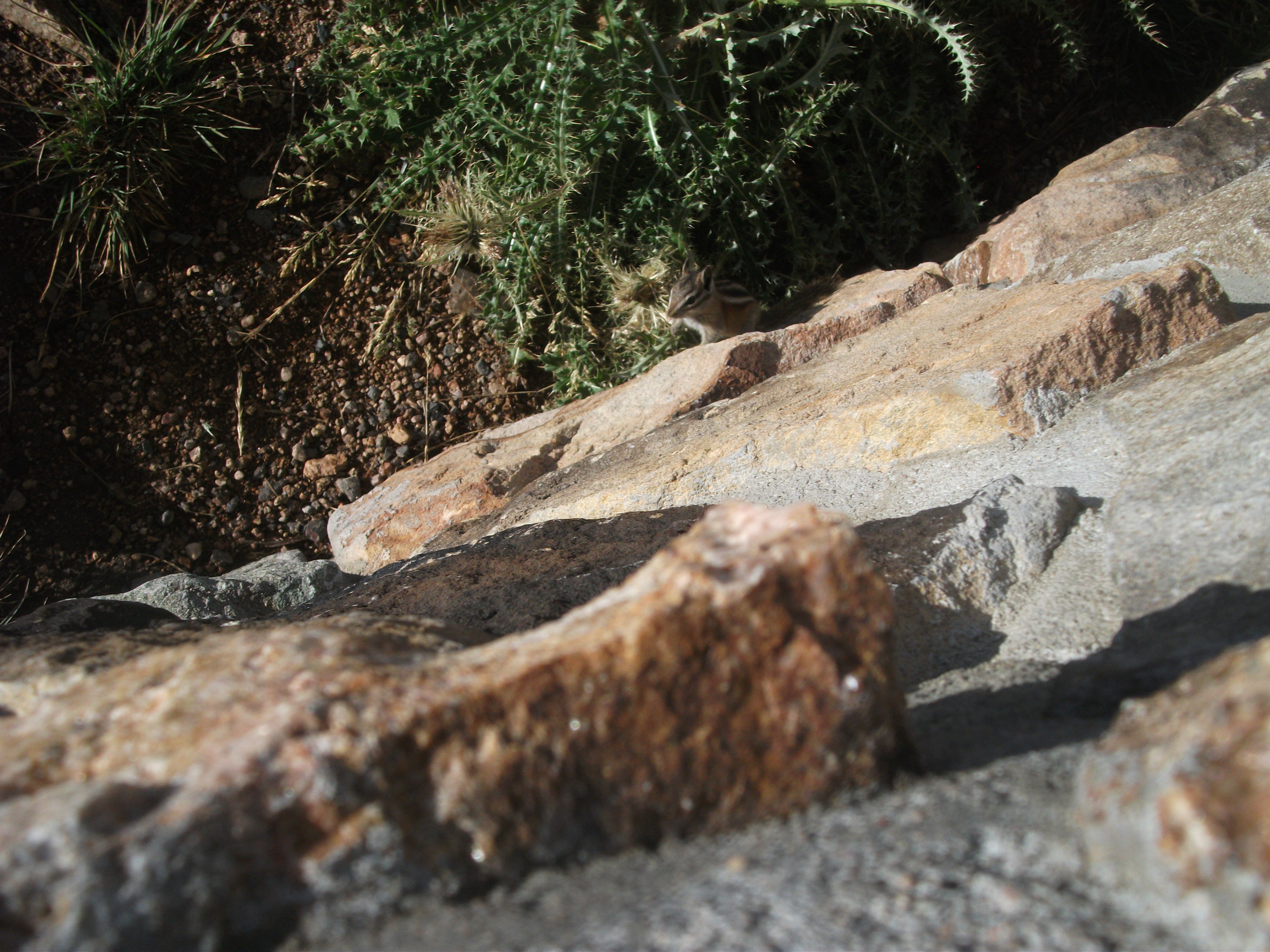
I think this is a great photo.
- Good depth. That rock wall is right in your face. As you look down the wall it becomes sharper focus and then leads to the chipmunk hiding in plain sight.
- Good balance. The location of the chipmunk is nice, because although the chipmunk doesn't stand out you find it pretty quickly. The wall divides the shot well, and I like the placement of the green patches contrasted with the bare earth.
- It's a cool little chipmunk hiding next to some sort of thistle.
Chipmunks have an omnivorous diet primarily consisting of seeds, nuts and other fruits, and buds. They mostly forage on the ground, but climb trees to obtain nuts such as hazelnuts and acorns. At the beginning of autumn, many species of chipmunk begin to stockpile nonperishable foods for winter. They mostly cache their foods in a larder in their burrows and remain in their nests until spring, unlike some other species which make many small caches of food. Cheek pouches allow chipmunks to carry food items to their burrows for either storage or consumption.
These small mammals fulfill several important functions in forest ecosystems. Their activities harvesting and hoarding tree seeds play a crucial role in seedling establishment. They consume many different kinds of fungi, including those involved in symbiotic mycorrhizal associations with trees, and are an important vector for dispersal of the spores of subterranean sporocarps (truffles) which have co-evolved with these and other mycophagous mammals and thus lost the ability to disperse their spores through the air.
Sourced from Wikipedia: https://en.wikipedia.org/wiki/Chipmunk
Marmot
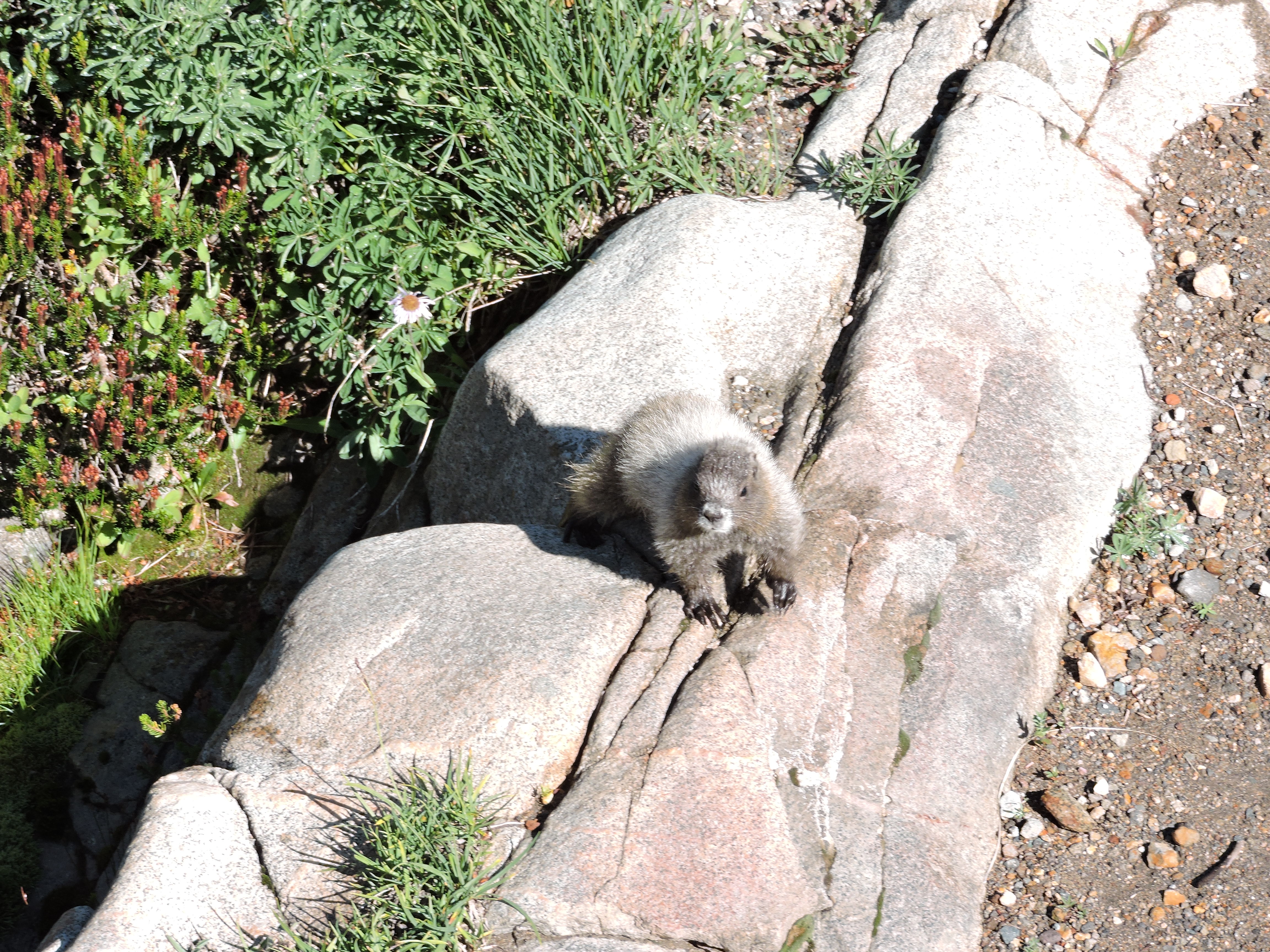
I happened to take a picture of a marmot.
- The marmot is posing well here.
Marmots typically live in burrows (often within rockpiles, particularly in the case of the yellow-bellied marmot and hibernate there through the winter. Most marmots are highly social and use loud whistles to communicate with one another, especially when alarmed. Marmots mainly eat greens and many types of grasses, berries, lichens, mosses, roots, and flowers.
Some species live in mountainous areas, such as the Alps, northern Apennines, Carpathians, Tatras, and Pyrenees in Europe; northwestern Asia; the Rocky Mountains, Black Hills, the Cascade and Pacific Ranges, and the Sierra Nevada in North America; and the Deosai Plateau in Pakistan and Ladakh in India. Other species prefer rough grassland and can be found widely across North America and the Eurasian Steppe.
Beginning in 2010, Alaska celebrates February 2 as "Marmot Day" a holiday intended to observe the prevalence of marmots in that state and take the place of Groundhog Day. ome species live in mountainous areas, such as the Alps, northern Apennines, Carpathians, Tatras, and Pyrenees in Europe; northwestern Asia; the Rocky Mountains, Black Hills, the Cascade and Pacific Ranges, and the Sierra Nevada in North America; and the Deosai Plateau in Pakistan and Ladakh in India. Other species prefer rough grassland and can be found widely across North America and the Eurasian Steppe.
Sourced from Wikipedia: https://en.wikipedia.org/wiki/Marmot
Deer
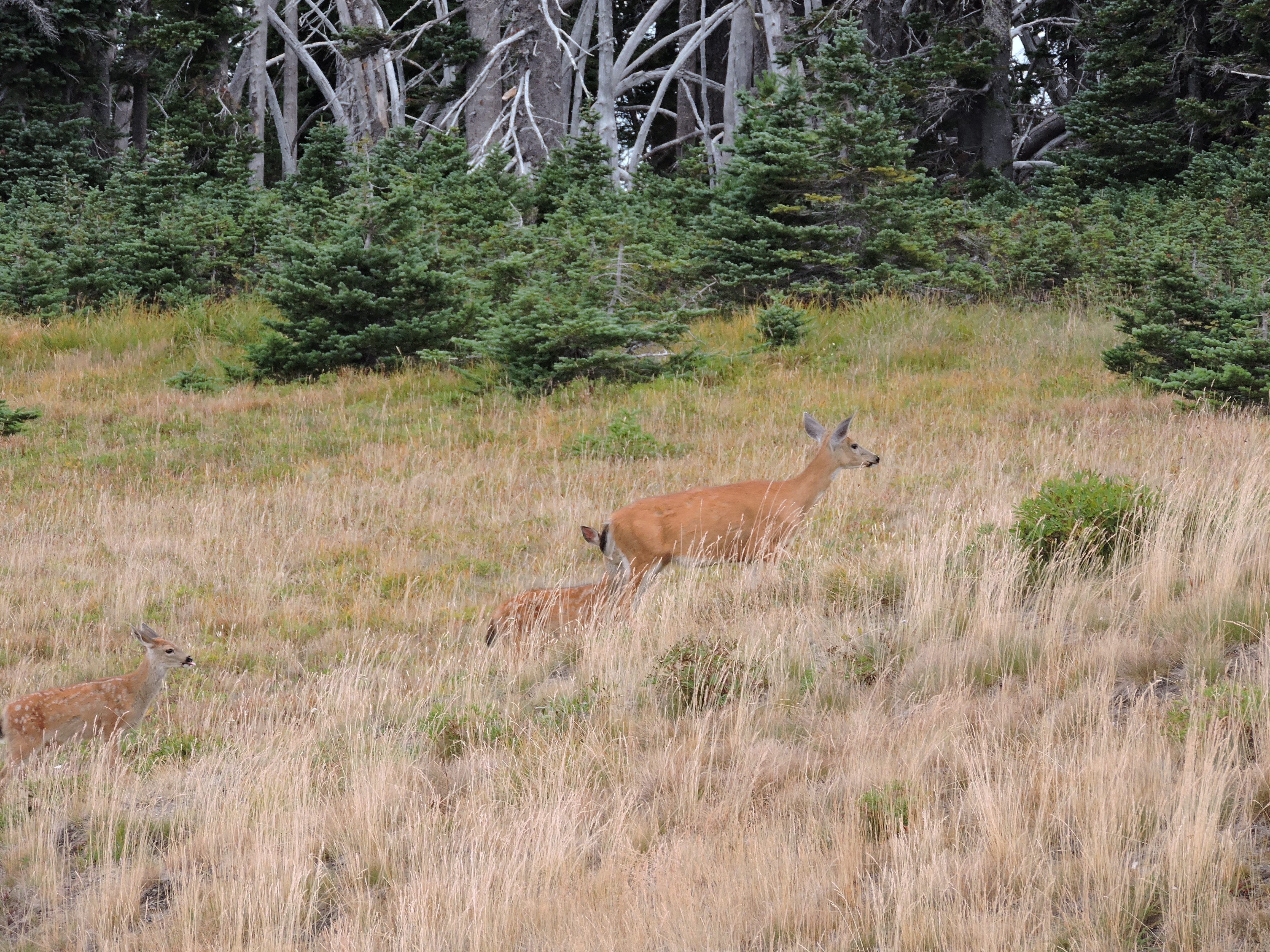
Here is a shot of deer walking in a field.
Deer appear in art from Paleolithic cave paintings onwards, and they have played a role in mythology, religion, and literature throughout history, as well as in heraldry. Their economic importance includes the use of their meat as venison, their skins as soft, strong buckskin, and their antlers as handles for knives.
They live in a variety of biomes, ranging from tundra to the tropical rainforest. While often associated with forests, many deer are ecotone species that live in transitional areas between forests and thickets for cover and prairie and savanna for open space. The majority of large deer species inhabit temperate mixed deciduous forest, mountain mixed coniferous forest, tropical seasonal/dry forest, and savanna habitats around the world.
Deer are browsers, and feed primarily on leaves. They have small, unspecialized stomachs by ruminant standards, and high nutrition requirements. Rather than eating and digesting vast quantities of low-grade fibrous food as, for example, sheep and cattle do, deer select easily digestible shoots, young leaves, fresh grasses, soft twigs, fruit, fungi, and lichens.
Sourced from Wikipedia: https://en.wikipedia.org/wiki/Deer